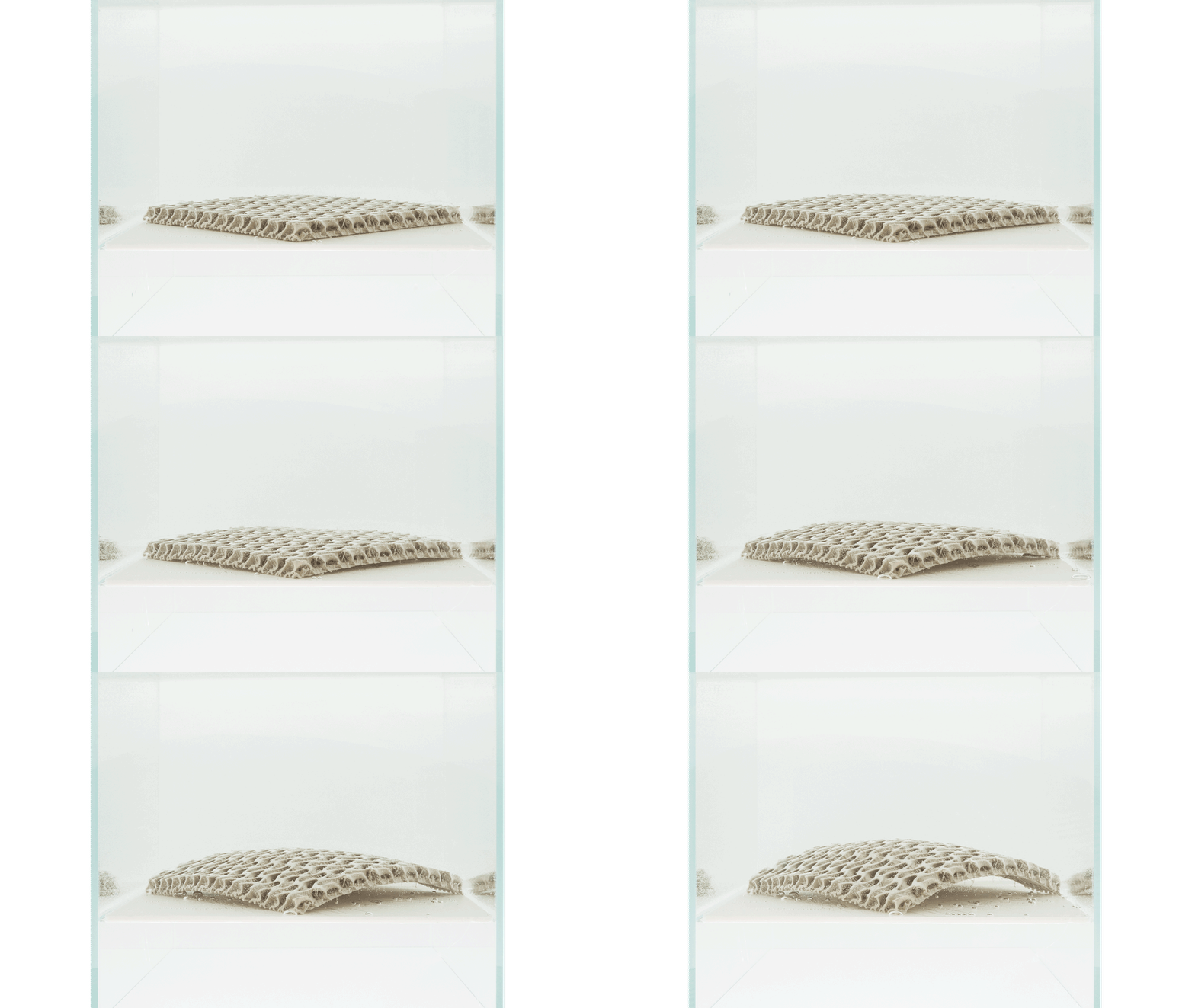
The built environment is a major driver of material use and waste, particularly in the fabrication of complex curved forms. Imagine a world instead where materials can do more with less. The objects around us might adapt passively, morphing their shapes in response to changes in the environment around them. This thesis project explores how complex curvature can emerge through printed passive self-shaping systems inspired by hygroscopic behaviors in nature, such as the pinecone, allowing designers to do more with less.
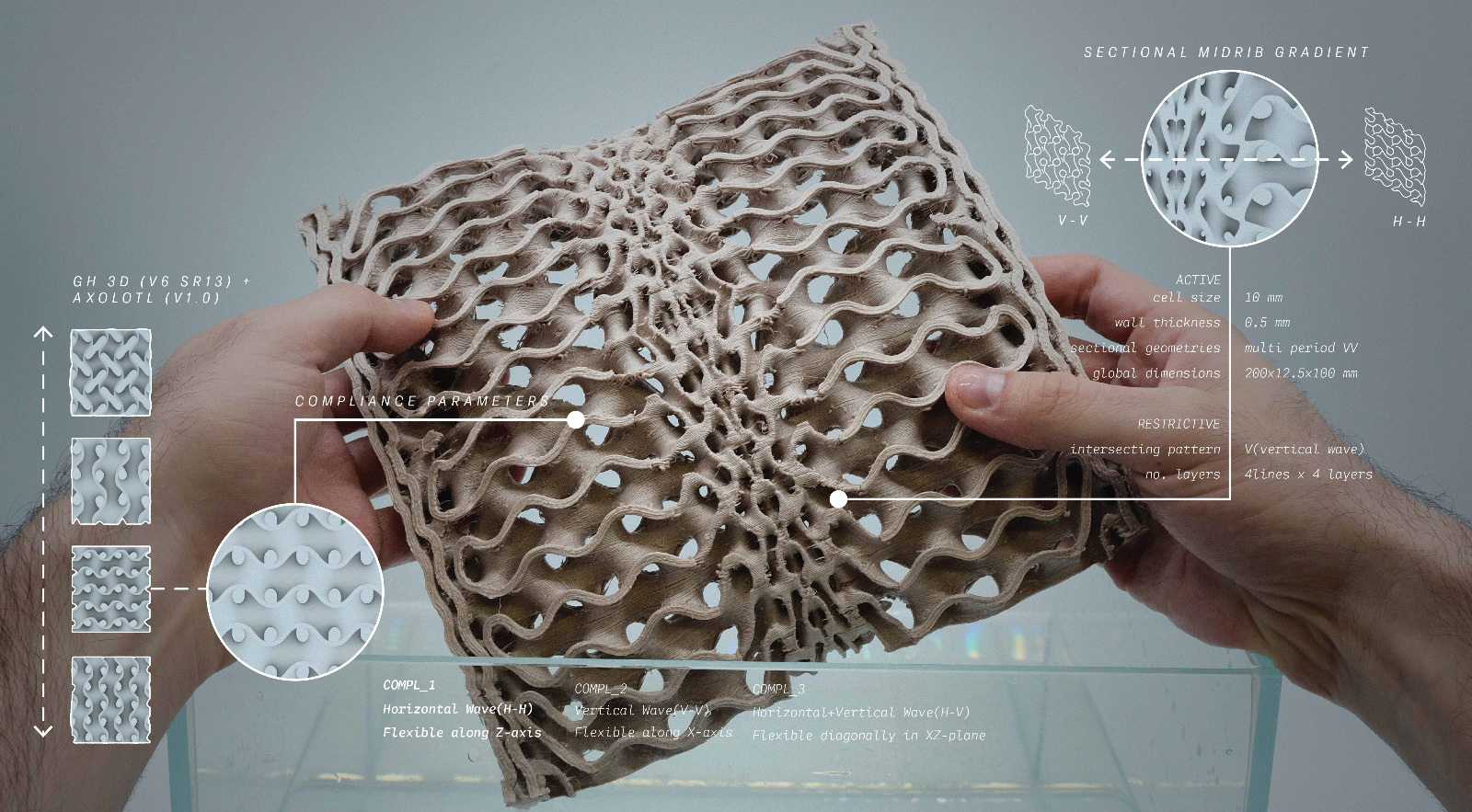
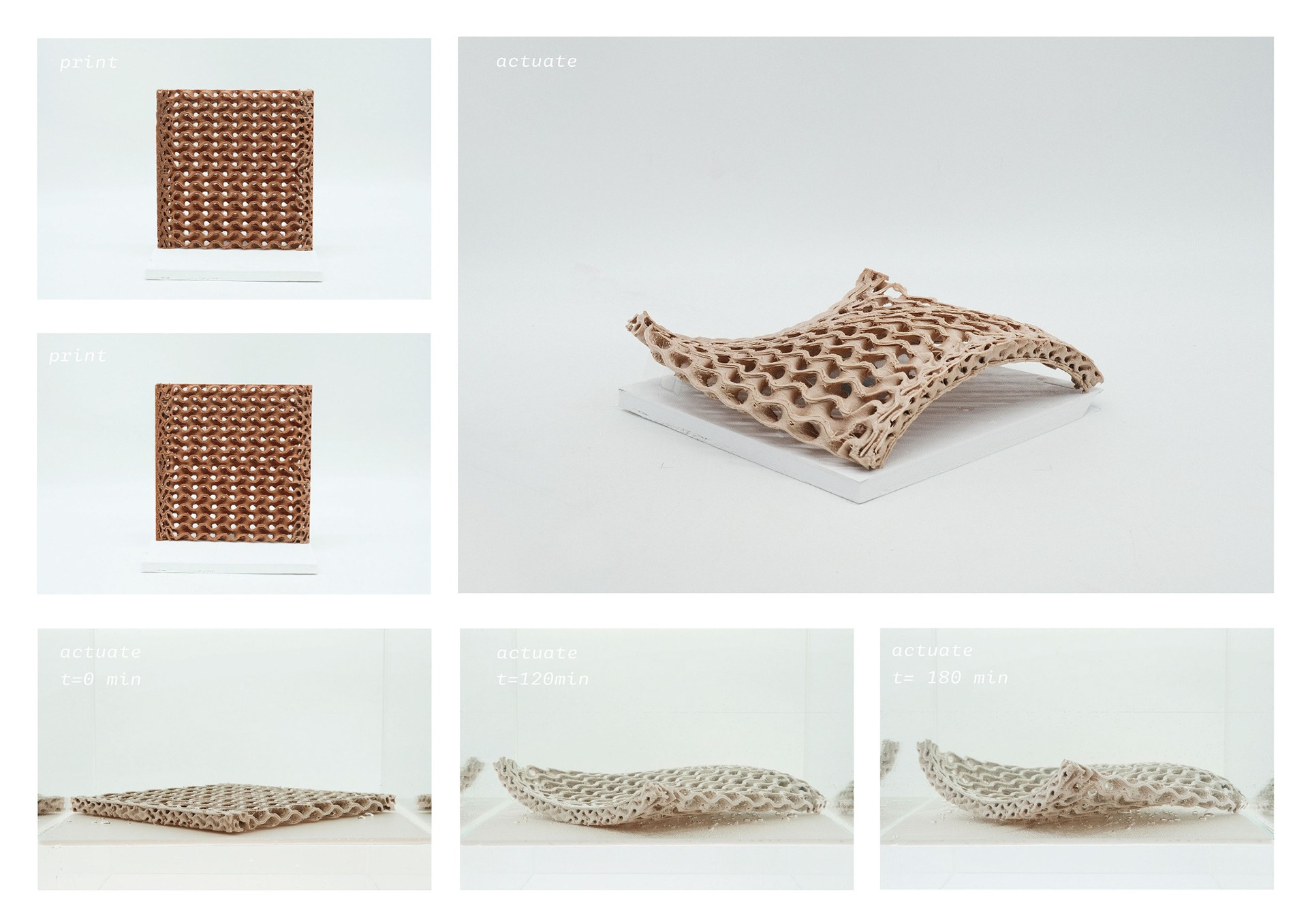
Through the creation of a novel printing method, Multi-step Sectional Four-Dimensional Printing (MS4DP), the research introduces a porous three-dimensional gyroid cell as a programmable building block for mono-material systems, overcoming key limitations of existing methods related to scale and the reliable formation of double curvature. By combining sectional patterning with modular gyroid geometries, flat prints transform into complex, doubly-curved forms through programmed self-shaping, demonstrating a materially efficient pathway toward responsive, lightweight fabrication.
Through iterative cycles of digital design and hands-on material testing, this project was structured as a series of explorations which build upon the findings of the previous. Fundamental experiments established differing behaviors of sectional gyroid patterns, identifying geometries with high anisotropy, directional compliance, or limited hygroscopic response.
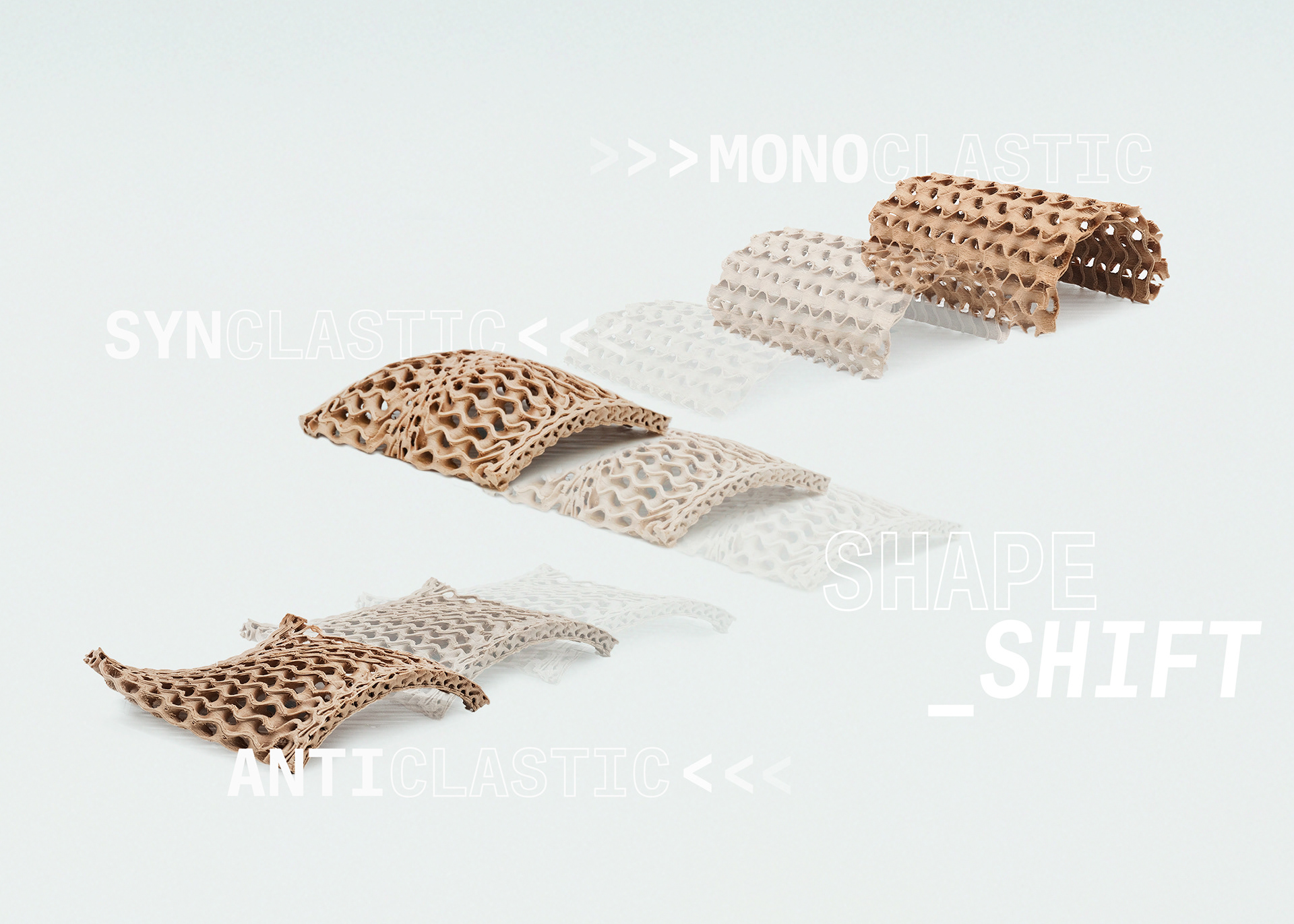
Different combinations of these patterns were used in two sectional self-shaping strategies to achieve monoclastic bending behavior. Next, two strategies were developed to incorporate different directions of bending into one object.
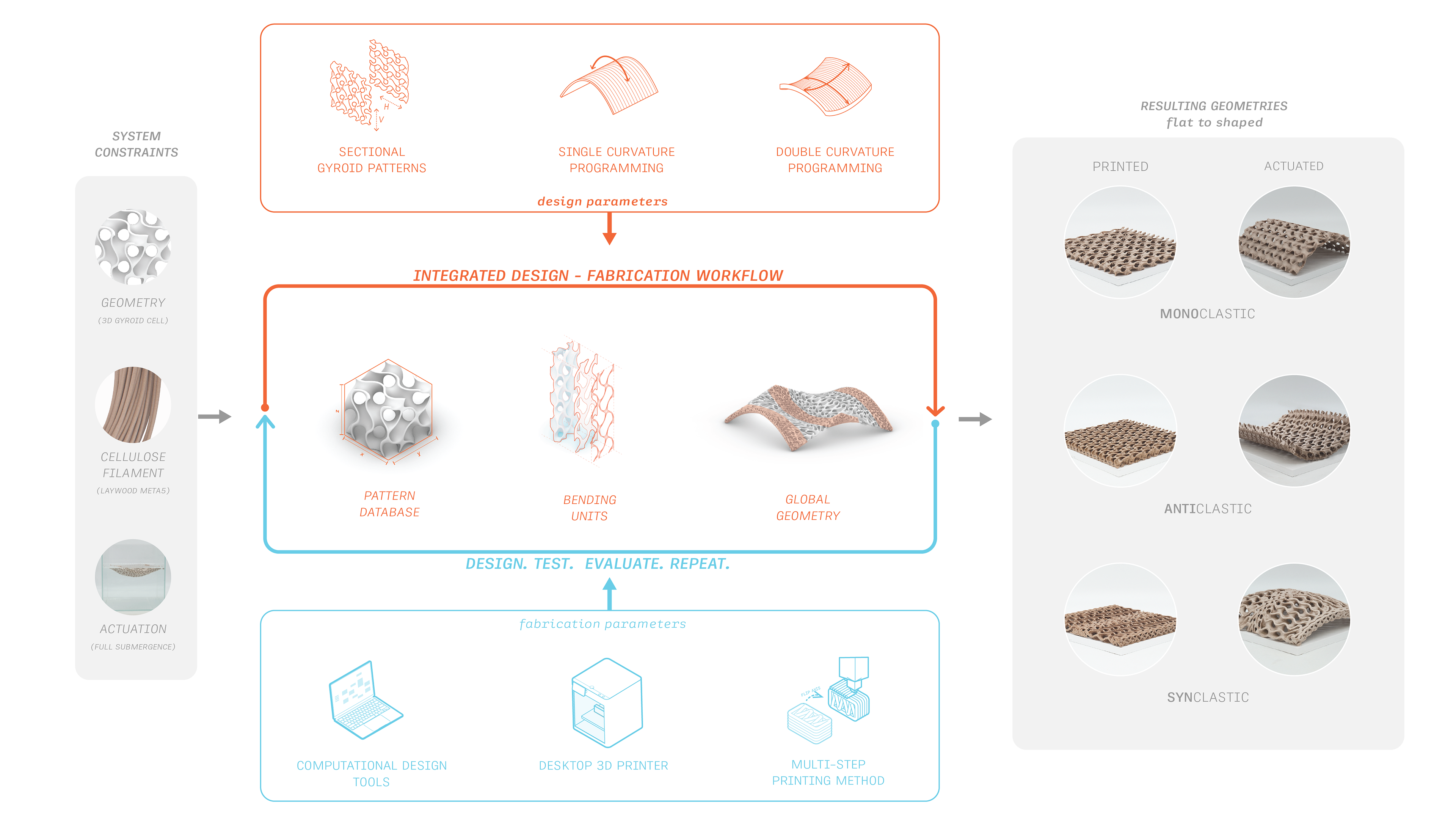
scope diagram
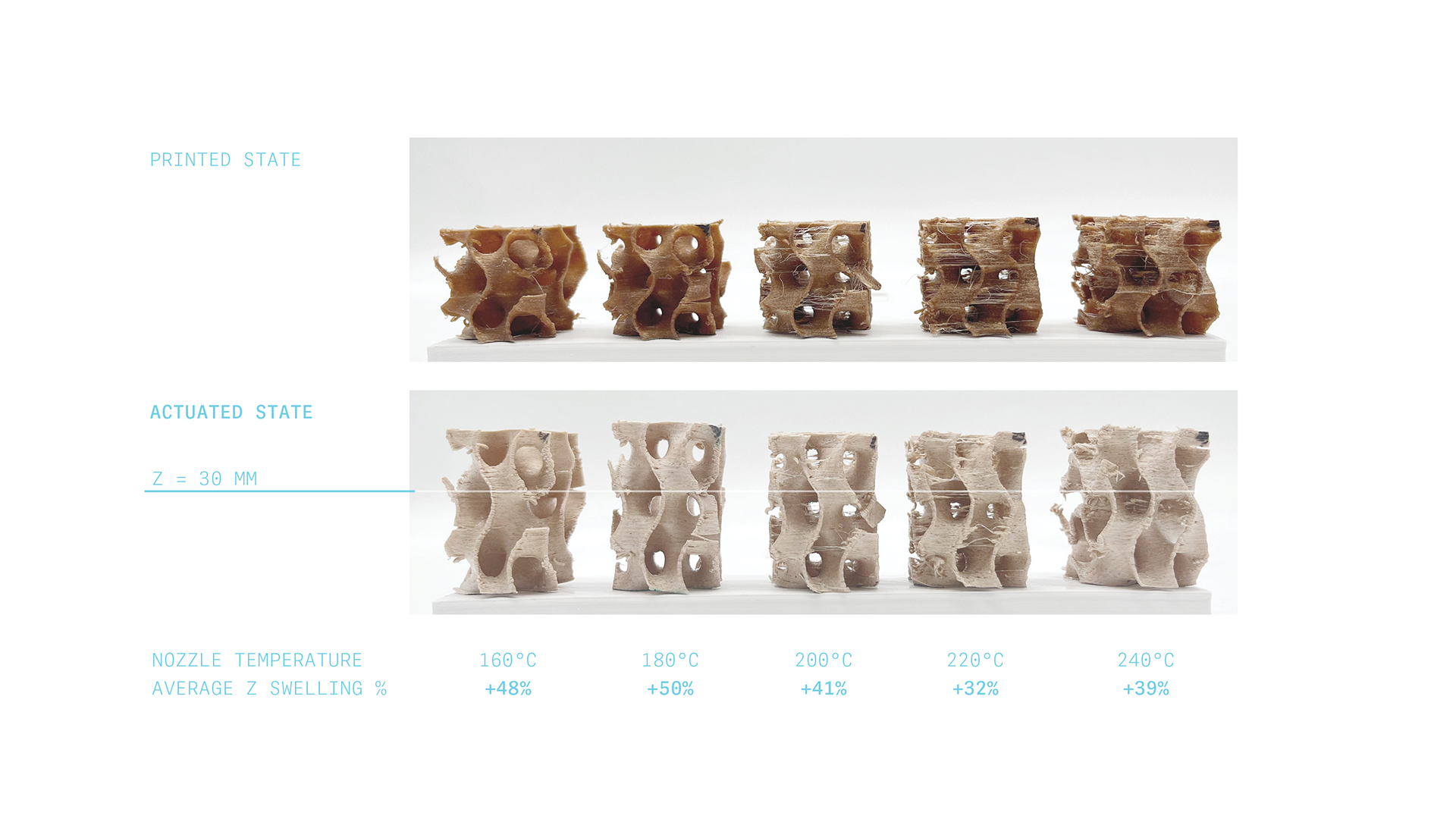
fundamental tests: nozzle temp
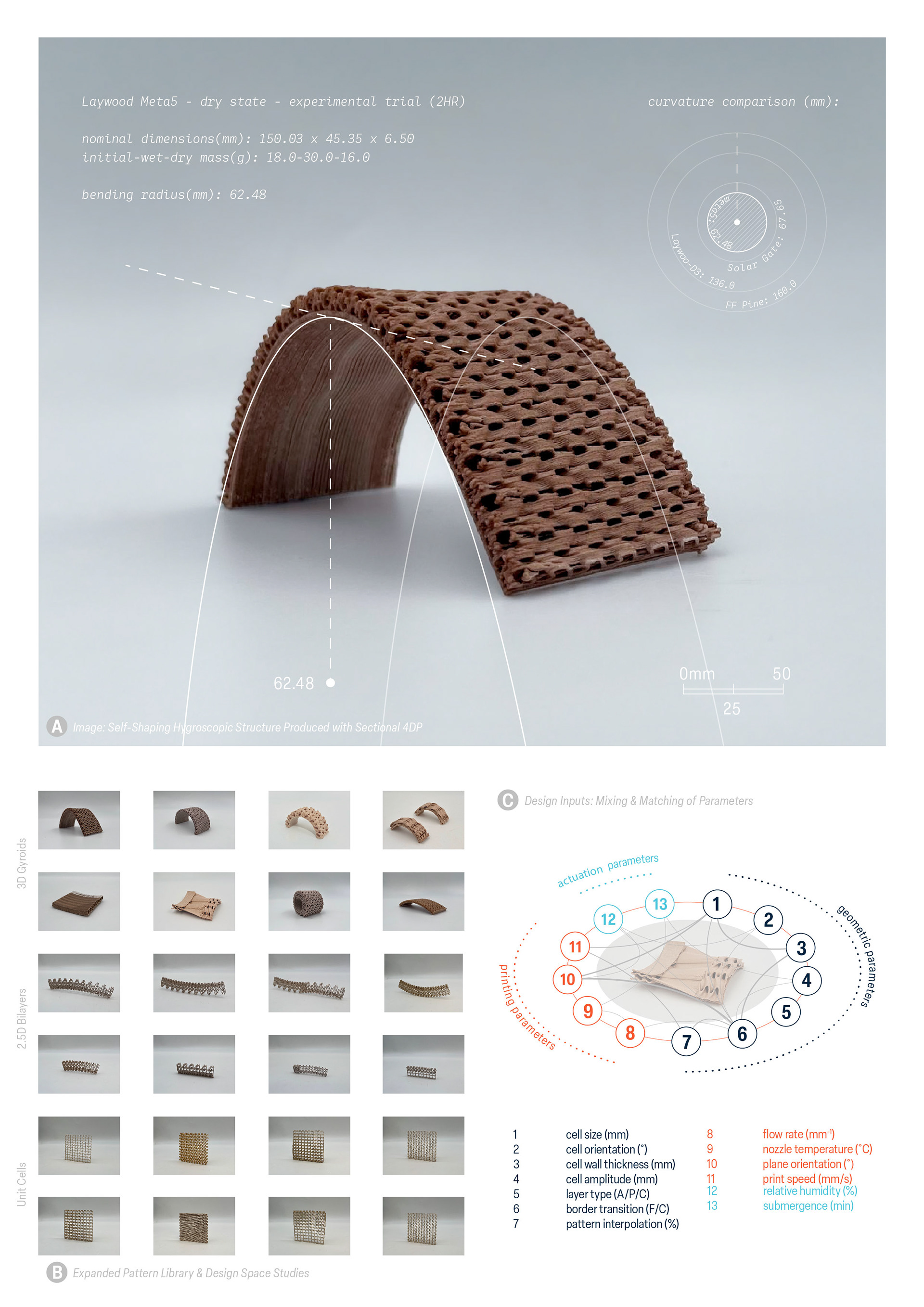
parameter studies
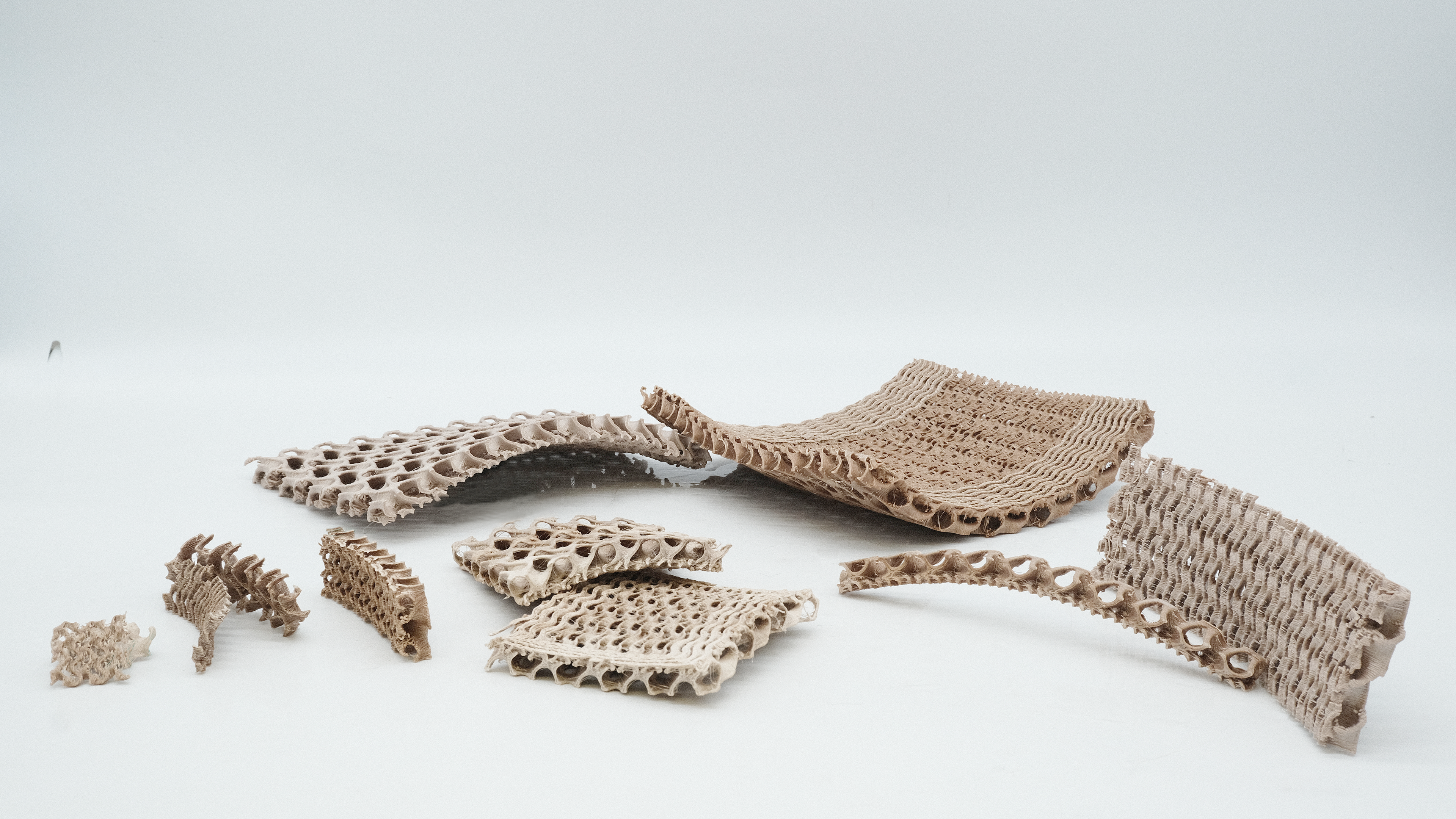
library of cross-sectional studies
Parameter testing identified key geometric and fabrication parameters that influenced the degree of shape change, such as cell size, aspect relationships, and nozzle temperature in both vertical and cross sectional bending mechanisms. With increased dimensional thickness, sectional samples demonstrate increased dimensional stability and load capacity compared to simple planar bilayers. This advancement could open the doors for more applications of self-shaping structures in architecture and industry.
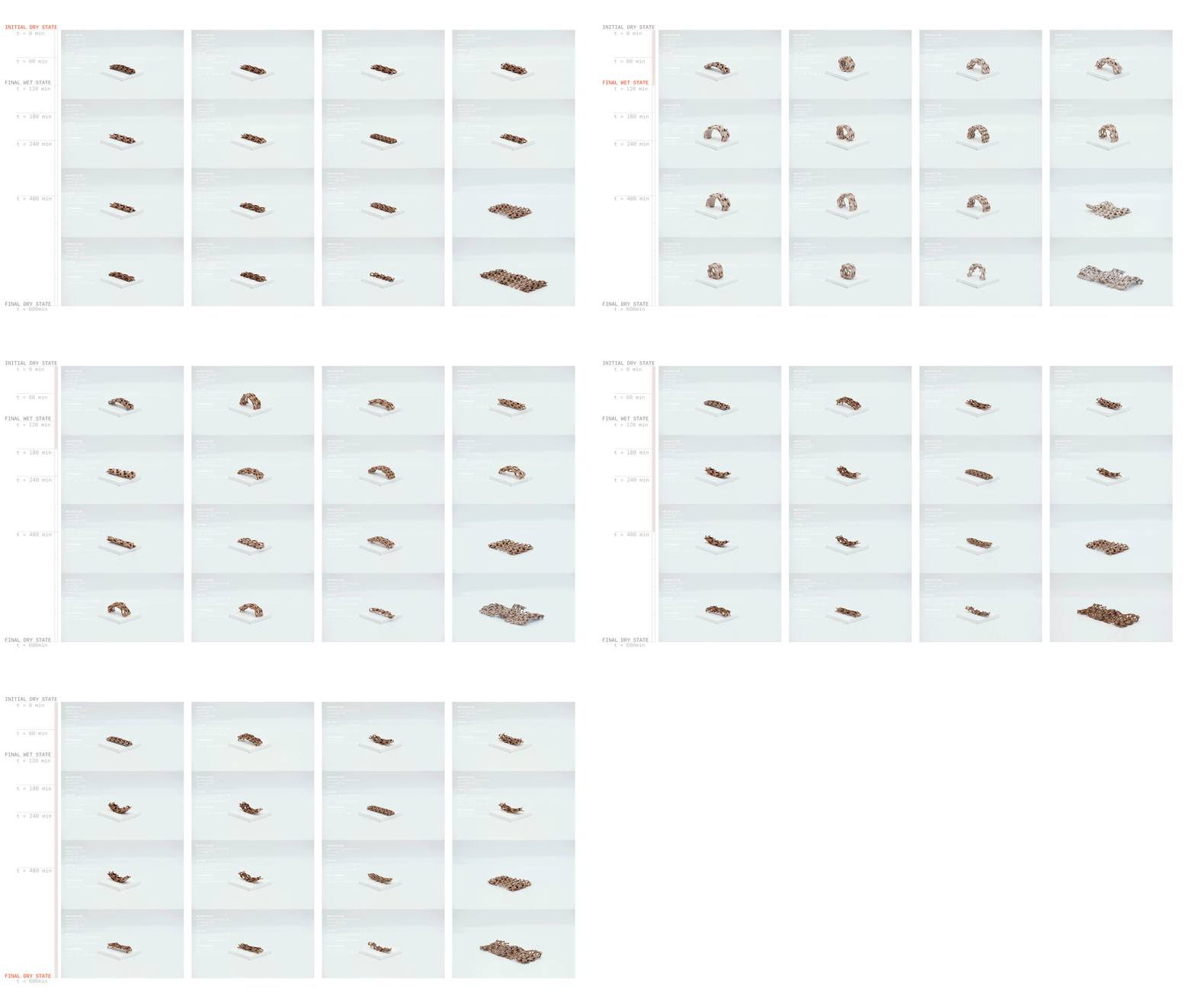
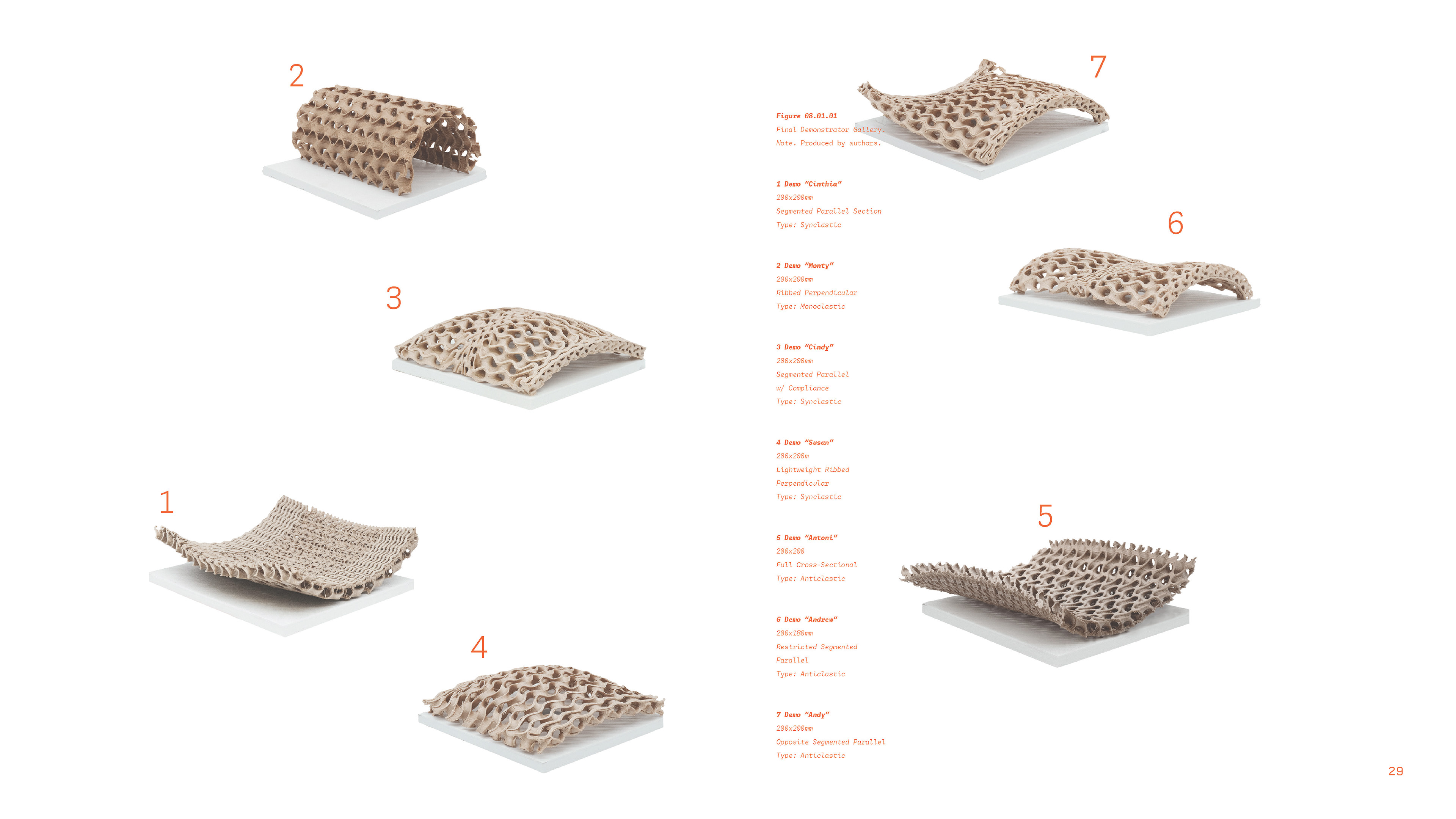
Parametric modeling in Axolotl enabled precise design of 3D gyroid-based geometries. Additional tools were used to introduce functional gradients and blends into the mesh geometry, improving print quality, material efficiency, and targeted performance. Swelling and shrinking data were compiled into a digital library to support future hygroscopic design research. Our investigation incrementally scaled from single bending units to increasingly complex, doubly-curved geometries, ultimately producing specimens measuring up to 200 × 200 × 13 mm. All strategies successfully achieve anticlastic and synclastic self-shaping behavior, transforming from flat printed panels into doubly-curved structures with significant depth.
While this project advances the possibilities of 4D printing, it also opens new directions for exploration. Future work could investigate methods for locking shaped states or designing reversible systems that transition between anticlastic and synclastic geometries in both dry and actuated conditions. With improved materials and more predictable behavior, self-shaping systems could enable architectural components that are fabricated flat, transported efficiently, and activated on site—reducing waste, energy use, and fabrication complexity while allowing structures to curve, unfold, and adapt autonomously.
Beyond fabrication, these principles suggest an architecture of responsive skins and passive movement, where buildings breathe, shift, and attune themselves to environmental change without motors or control systems. By embedding a quiet intelligence within materials, architecture may become both more functional and expressive—responding slowly, in rhythms that reconnect us to time, place, and natural cycles.